 Favourite Villages Favourite Villages
|
|
|
NEW FLIGHTS TO
VOLOS AIRPORT |
|
|
|
 |
 |
|
| Favourite sea-side
resorts |
|
|
|
| Pelion |
|
|
| Activities |
|
|
|
 A mountain
for all seasons ! A mountain
for all seasons ! |
|
 |
Spring
in Pelion is a little late in coming
especially in the higher altitudes. It
usually sets in in mid April and the
entire May, when one can virtually watch
buds turn into blossoms and blossoms
into leaves and fruits. The mountain,
now stripped of snow... |
 |

Summer
is paradise come to Pelion. Nature is
at its best: lush vegetation, pretty
flowers and blossoms, all sorts of fruit
ripening on the trees, bees flitting
from aromatic herbs to blooming honeysuckle,
nightingales serenading the huge full
moon... |
 |
Early
Fall has its own special beauty. The
foliage sings its swan song in variegated
colours. When one walks in the woods
his eyes feast in rainbow colours. It
is chestnut and walnut season, and in
case one does not notice it, the squirrels
will see to it as they busy... |
 |
Winter
is time when the Pelion villages, unspoilt
and pretty as ever, come out of hiding
and become visible. The weather conditions
vary depending on the altitude and the
general weather pattern. There are long
periods of beautiful sunlit days with... |
|
|
 |
|
 |
| The Little
Train of Pelion |
|
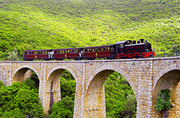 The
narrow gauge Little Train of Pelion
[gauge of 60 cm] started operating
between Volos and Lehonia in 1895
and between Lehonia and Milies in
1903, covering a total distance of
approximately 29 klm. It was ingeniously
designed and constructed by the Italian
engineer Evaristo de Chirico, father
of the world renowned surrealist painter
Giorgio de Chirico, who, born and
schooled in the area, drew his thematology
for the metaphysical period of his
work especially from his childhood
memories of the mountain of the Centaurs
and Argonauts. The train was instrumental
in the economic and cultural development
of Pelion by making distances shorter
and thereby facilitating the transportation
of both goods and people, and, more
importantly, by rendering the dissemination
of ideas easier and more effective,
given the fact that the mountain,
especially in the north, is high and
steep and therefore not easily accessible.
Having been superseded by the motor
vehicle, however, the Little Train
was decommissioned in 1971 because
it was deemed to be uneconomical.
Despite this, his friends never forgot
their "Moudzouris" [an endearing
term meaning "the smoky train"],
and, after applying pressure to the
right quarters, they managed to have
it reinstated into service after about
25 years. Today it operates at weekends
in high season only for tourist purposes,
and a ride on it is the favourite
excursion of Pelion visitors of all
ages and nationalities. The
narrow gauge Little Train of Pelion
[gauge of 60 cm] started operating
between Volos and Lehonia in 1895
and between Lehonia and Milies in
1903, covering a total distance of
approximately 29 klm. It was ingeniously
designed and constructed by the Italian
engineer Evaristo de Chirico, father
of the world renowned surrealist painter
Giorgio de Chirico, who, born and
schooled in the area, drew his thematology
for the metaphysical period of his
work especially from his childhood
memories of the mountain of the Centaurs
and Argonauts. The train was instrumental
in the economic and cultural development
of Pelion by making distances shorter
and thereby facilitating the transportation
of both goods and people, and, more
importantly, by rendering the dissemination
of ideas easier and more effective,
given the fact that the mountain,
especially in the north, is high and
steep and therefore not easily accessible.
Having been superseded by the motor
vehicle, however, the Little Train
was decommissioned in 1971 because
it was deemed to be uneconomical.
Despite this, his friends never forgot
their "Moudzouris" [an endearing
term meaning "the smoky train"],
and, after applying pressure to the
right quarters, they managed to have
it reinstated into service after about
25 years. Today it operates at weekends
in high season only for tourist purposes,
and a ride on it is the favourite
excursion of Pelion visitors of all
ages and nationalities. |
|
|
|
|
|
 |
|
| Accommodation |
|
|
| Related Links
|
|
|
| Newsletter
|
|
|
| < |
|





